Age Guides|
Best Smartwatches for 4-Year-Olds (2026): What Actually Works at This Age
Is 4 too young for a smartwatch? We tested 3 watches with a preschooler to find out which ones a 4-year-old can actually wear, operate, and benefit from.
Finding a smartwatch a 5-year-old can actually use isn't easy. We tested 8 watches with a kindergartner to find the ones that are truly young-kid friendly.
Jiobit Smart Tag
~$130
Affiliate Disclosure: This article contains affiliate links. If you purchase through our links, we may earn a small commission at no extra cost to you. We only recommend products we have personally tested and believe in. Our opinions are our own and are not influenced by any affiliate partnerships.
Top pick: For a five-year-old who wants an actual watch with calling and SOS, the Gabb Watch 3e ($229.99) is my top choice -- its photo-based contacts and no-games, no-internet interface are the easiest for a pre-reader to operate. If you just need GPS peace of mind, the clip-on Jiobit Smart Tag ($130) tracks all week on one charge, and the Garmin Vivofit Jr. 3 ($90) is the best no-subscription option thanks to its year-long battery and chore system.
Let me be honest with you right up front: most "kids smartwatches" are not designed for five-year-olds. They are designed for eight-to-twelve-year-olds and then marketed with a nice broad "ages 4+" label on the box. I know this because I strapped eight different watches onto our 5-year-old tester and watched what actually happened.
What happened was enlightening. And occasionally hilarious. And once, briefly, terrifying when he told me he "put the watch somewhere safe" and that somewhere turned out to be inside the toilet tank. Not the bowl. The tank. He lifted the lid off the back of the toilet and placed it in there like a little treasure chest. We will get to water resistance ratings later, but I want you to know the level of chaos we are working with here.
Five-year-olds are a special engineering challenge. Their wrists are genuinely tiny, usually around 4.5 to 5.5 inches in circumference. Most of them cannot read beyond basic sight words. Their fine motor skills are still developing, so swiping through three layers of menus is not realistic. They have the attention span of a caffeinated goldfish. And they will absolutely, without hesitation, show every single kid at the lunch table this cool new thing on their wrist, which means it needs to survive being grabbed, yanked, poked, and occasionally licked by an entire kindergarten class.
I spent six weeks testing watches with our kindergarten-age tester to find the ones that a five-year-old can genuinely operate, that parents can actually rely on, and that will survive the experience. Here is what I found.
Before we get to specific products, I want to walk through the criteria I used. These are not the same criteria I would use for an eight-year-old, and that distinction matters.
This eliminates more watches than you might expect. A watch case that is 42mm or wider will look and feel like a dinner plate on a kindergartner's wrist. I measured our tester's wrist at 5.1 inches, which is right in the middle of the normal range for his age. Several popular watches simply could not tighten enough on the smallest band hole, and others technically fit but were so bulky that he kept banging the screen on tables, door frames, and his own face.
For most parents, the entire reason to buy a watch for a five-year-old is the SOS button. If your child needs help, they need to press one button and reach you. Not navigate to a contacts screen, scroll down, find your name, and tap call. One button. That is the standard. If a watch cannot do that, it fails the most important test. We cover SOS, geofencing, and other protective features in detail in our kids smartwatch safety features guide.
Our tester wore each watch to school, to the playground, to swim class (where applicable), and through normal five-year-old life, which involves an astonishing amount of falling down, crashing into things, and jamming hands into sand. The watch needs to handle all of it.
A five-year-old cannot be trusted to charge a device. Period. If the battery dies at 1 PM and you are counting on GPS tracking for after-school pickup, that is a serious problem. I need a watch to last from 7 AM to 6 PM at minimum, and ideally longer so you are not stressing about it every single night.
Your five-year-old should not be the one configuring this device. You need to be able to set contacts, enable or disable features, set school mode schedules, and adjust geofence zones all from your phone. Every watch on this list supports that.
This is the big one for kindergarten parents. If the watch has games on it, your child's teacher will find out approximately fourteen seconds after your kid walks into the classroom. I have gotten emails from teachers. I am sympathetic to both sides. For a five-year-old, fewer features is genuinely better. They do not need a calculator, a web browser, or fifteen pre-loaded games. They need to call mom, press SOS if something is wrong, and maybe take a goofy photo once in a while.
| Feature | Jiobit Smart Tag | Gabb Watch 3e | Xplora XGO3 | Cosmo JrTrack 2 | Garmin Vivofit Jr. 3 |
|---|---|---|---|---|---|
| Price | ~$130 | $229.99 | ~$80 | ~$100 | ~$90 |
| Type | GPS tracker (clip-on) | Smartwatch | Smartwatch | Smartwatch | Activity tracker |
| Wrist Fit (Age 5) | N/A (clips on) | Good | Good | Acceptable | Excellent |
| Simplicity Rating | 10/10 | 8/10 | 7/10 | 7/10 | 9/10 |
| GPS Tracking | Yes (excellent) | Yes | Yes | Yes | No |
| SOS Button | No (alerts via app) | Yes | Yes | Yes | No |
| Durability | Excellent | Good | Good | Good | Excellent |
| Battery Life | 5-7 days | 1-2 days | 1-1.5 days | 1-1.5 days | Up to 1 year |
| Monthly Plan | ~$13/month | $12.99-$17.99/month | ~$10/month | ~$10/month | None |
| Games | None | None | Minimal | Minimal | App-based chores |
| Calling | No | Yes | Yes | Yes | No |
I know what you are thinking. "Ryan, this is not a watch." You are correct. And that might be exactly why it is the best option for your five-year-old.
Here is the reality I discovered after weeks of testing: some five-year-olds are simply not ready for a wrist-worn device. Our primary tester could handle a watch, but another 5-year-old in our testing group, who I also tested a few watches with during playdates (with his parents' permission), could not stop fiddling with it, kept taking it off, and got it confiscated by his teacher on day two. For kids like that, the Jiobit is the answer.
The Jiobit is a small, lightweight GPS tracker that clips onto a belt loop, backpack strap, shoe, or jacket. Your child does not interact with it at all. There is no screen to break, no buttons to accidentally press during quiet reading time, and nothing to show off to friends. It just silently tracks location and reports to your phone.
The GPS accuracy is the best I have tested in any kids tracking device. It uses a combination of GPS, cellular, Wi-Fi, and Bluetooth to pinpoint location, and in my testing it was consistently accurate within about 15 to 30 feet. The battery lasts five to seven days, which is extraordinary. I charged it on Sunday nights and forgot about it until the following weekend.
The companion app lets you set up geofence alerts (I got a notification when our tester arrived at school and when he left), view location history, and share access with other caregivers. The whole experience is set-it-and-forget-it, which is exactly what you want with a kindergartner.
The downside: your child cannot call you from a Jiobit. There is no SOS button they can press. It is a tracking device, not a communication device. For some parents, that is a dealbreaker. For others, especially those whose five-year-old is always with a trusted adult (school, daycare, grandparents), the tracking alone provides enormous peace of mind.
Pros:
Cons:
Can a 5-year-old operate it independently? They do not need to. That is the whole point.
If your five-year-old specifically wants a watch on their wrist and you need calling and SOS functionality, the Gabb Watch 3e is my top recommendation. Gabb has built its entire brand around the idea of giving kids connectivity without the junk, and it shows in this product.
The interface is clean and simple. The home screen shows the time with a large, easy-to-read display. Our tester could tell the time on it, which was a bonus since we have been working on that skill. Swiping left pulls up contacts, which display as photos rather than names. This is critical for five-year-olds. A kindergartner cannot read "Grandma" on a tiny screen, but he can absolutely recognize Grandma's face. I pre-loaded five contacts with clear photos and he had no trouble calling any of them within the first day.
The SOS button is prominent and easy to activate. We practiced it together several times. Press and hold the side button, and it immediately calls the primary emergency contact while simultaneously sending a GPS location ping. Our tester understood it after two practice rounds.
There are no games on this watch. No internet. No app store. It makes calls, sends basic preset messages, tracks location, and counts steps. That is it. I cannot overstate how much this matters for the kindergarten age group. Our tester never got in trouble at school, never sat at dinner ignoring the family to play on his wrist, and never had a meltdown because we took the watch away. It was just a watch that could call mom and dad.
The band fits five-year-old wrists on the smaller holes, though I will note that the watch face is still a bit large for the tiniest kids. Our tester is average-sized for his age and it looked proportional. If your child is on the smaller side, try it on in person if possible.
Battery life was solid. I consistently got a full day and often stretched into the morning of day two before needing a charge. Not incredible, but perfectly adequate for the daily routine.
Pros:
Cons:
Can a 5-year-old operate it independently? Yes. After about two days of practice, our tester could make calls, answer calls, and activate SOS without any help. The photo-based contacts are the key feature that makes this work for young kids.
The Xplora XGO3 is the smaller, simpler sibling of the popular X6Play, and that is exactly what makes it a contender for five-year-olds. It is less expensive, less feature-packed, and physically smaller, all of which are advantages at this age.
The XGO3 includes GPS tracking, SOS, calling to pre-approved contacts, a basic camera, and a step counter. The camera was a surprise hit with our tester. He took approximately four hundred photos in the first week, roughly 390 of which were of his own nostril or the ceiling. But he was thrilled about it, and it gave the watch a "fun factor" that the more stripped-down options lack.
The interface requires a bit more swiping than the Gabb Watch 3e, which is my main concern for the youngest users. Our tester needed about four days before he could navigate reliably without getting lost in menus. A seven-year-old would pick it up in an afternoon, but five-year-olds move a little slower on this kind of thing, and that is okay. Once he learned the layout, he was fine.
The SOS function works well. Press and hold the side button and it cycles through emergency contacts until someone answers, while also sending location data. The GPS accuracy was respectable, usually within 30 to 50 feet in our testing.
At around $80 for the device, this is the most affordable cellular smartwatch on the list. For more affordable picks across all age groups, see our best budget smartwatches under $100. You will still need a monthly plan for the SIM, but the upfront cost is easier to stomach, especially when you are not sure whether your kid is ready for a watch at all. If it ends up in the toilet tank after two weeks, you are out $80 instead of $150.
Pros:
Cons:
Can a 5-year-old operate it independently? Yes, but expect a learning curve of about four to five days. The camera and SOS are easy right away. Navigating to contacts and making calls takes a bit more practice.
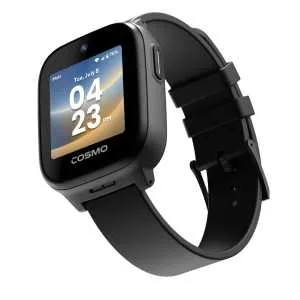
The Cosmo JrTrack 2 deserves a spot on this list because of its genuinely kid-friendly user interface. The designers clearly thought about young children when they built the software. Icons are large and colorful, navigation is mostly swipe-based with big tap targets, and the overall aesthetic feels like it was designed for a kids product rather than being a shrunken-down adult interface.
GPS tracking, two-way calling, SOS, and messaging are all present. The SOS function works the same as most competitors: hold the dedicated button and it calls your preset emergency contact while broadcasting location. In testing, it was reliable every time our tester tried it.
Where the JrTrack 2 falls slightly short for five-year-olds is physical size. The watch is a bit bulkier than the Xplora XGO3, and on our tester's wrist it looked noticeably large. It never fell off and the band tightened enough, but he complained about it being "heavy" during the first few days. He eventually stopped mentioning it, but the initial adjustment was rougher than with the Gabb or Xplora.
The companion app for parents is well designed. I could see the tester's location, set up geofences, manage his contact list, control which features were available, and set school mode schedules. The location updates were frequent and reasonably accurate.
I will note that the JrTrack 2 does include a few game-like features. You can disable them through the parent app, and I would strongly recommend doing so for a five-year-old. Our tester discovered a math game on it within the first hour and spent the rest of the evening ignoring his dinner to play it. Once I disabled games remotely, the watch became a much better tool.
Pros:
Cons:
Can a 5-year-old operate it independently? Mostly yes. The big colorful icons help. Making calls and using SOS were easy for our tester. The overall navigation took about three days to click. The physical size was the bigger issue.
The Garmin Vivofit Jr. 3 is a completely different kind of device, and I want to be upfront about what it is and is not. It is not a GPS tracker. It is not a phone. Your child cannot call you from it and you cannot see their location on a map. If those features are your primary motivation, skip this one.
What the Vivofit Jr. 3 does is everything else, and it does it brilliantly.
This is an activity tracker with a one-year battery life. Let me say that again. One. Year. You put a standard coin-cell battery in it and forget about charging for an entire year. For a five-year-old who cannot remember to put on shoes, let alone charge a watch every night, this is transformative. It simply always works.
The watch is themed with Disney, Marvel, and other characters that kindergartners are obsessed with. Our tester got the Marvel Avengers version and I am not exaggerating when I tell you he slept with it on for the first week. The themed watch faces change as kids hit activity goals throughout the day, which is a clever motivational trick that genuinely worked on him.
The companion app (managed by parents) lets you assign chores and tasks with reward systems. "Brush your teeth" earns coins. "Pick up your toys" earns coins. Coins unlock adventures in the app. We had been struggling with the morning routine for months, and the Vivofit Jr. 3 fixed it in three days. Our tester was brushing his teeth without being asked because he wanted to earn coins and unlock the next chapter of his Avengers adventure. I almost cried.
The watch itself is incredibly durable. It is swim-proof, kid-proof, and the silicone band fits small wrists perfectly. This is one of the few watches on this list where I had zero concerns about the fit on a five-year-old. It looked proportional and comfortable from day one.
Pros:
Cons:
Can a 5-year-old operate it independently? Absolutely. Our tester understood it within the first hour. Check the time, see your steps, see your chore list. That is it. The simplicity is the entire point, and for this age group, it works perfectly.
I get this question constantly, so let me address it directly. Can you set up an Apple Watch for a five-year-old using Apple's Family Setup feature?
Technically, yes. Should you? No. Not at age five.
The Apple Watch SE, which is the most affordable option, has a case size of 40mm and a strap that barely tightens enough for most five-year-old wrists. It looked comically large on our tester, like he was wearing a clock from the wall. Beyond the physical fit, the interface is designed for adults. The icons are small, the text is tiny, the swipe gestures require a level of precision that developing fine motor skills simply cannot deliver consistently.
Then there is the price. An Apple Watch SE runs about $250, and you need a cellular plan on top of that. When your child is one sandbox accident away from destroying the device, that is a painful price tag.
The Apple Watch is a fantastic option starting around age eight or nine when kids are bigger, more coordinated, and more capable of managing a complex device. It shows up on our list of the best GPS smartwatches for kids for good reason -- just not for this age group. For a five-year-old, it is overkill in every dimension.
This section exists because I wasted money learning this lesson and I do not want you to repeat my mistake.
The average wrist circumference for a five-year-old is approximately 4.5 to 5.5 inches (11.5 to 14 cm). Grab a flexible tape measure or a piece of string and measure your child's wrist right now. I will wait.
Here is how the watches on this list actually fit at that size:
| Watch | Minimum Band Circumference | Fits Average 5-Year-Old Wrist? | Notes |
|---|---|---|---|
| Jiobit Smart Tag | N/A (clip-on) | N/A | Clips to clothing, belt, shoe, or bag |
| Gabb Watch 3e | ~5.0 inches | Yes, on smallest holes | Snug fit for smaller wrists, may need extra hole |
| Xplora XGO3 | ~4.7 inches | Yes | Good fit on smaller holes |
| Cosmo JrTrack 2 | ~5.2 inches | Tight for small wrists | May need extra hole punched for smallest wrists |
| Garmin Vivofit Jr. 3 | ~4.3 inches | Yes, excellent fit | Designed specifically for young children |
Tips for band sizing:
Getting the watch is half the battle. Setting it up correctly for a young child is the other half. Here is what I learned through trial and error.
This is the single most important setup tip. A five-year-old who is stressed or scared is not going to read a contact list. They need to see faces. Every watch on this list that supports calling allows you to assign photos to contacts. Take clear, well-lit headshots of Mom, Dad, Grandma, and whoever else is in the emergency contact rotation. Load them into the watch before you hand it to your child.
Do not just show your child the SOS button once. Practice it. Make it a game. "Okay buddy, pretend you are lost. What do you do?" We practiced at least a dozen times over the first week, in the house, at the park, in the car. By the end of the week, he could activate SOS without thinking about it. That is what you want.
Set the school mode schedule before the first school day. School mode disables everything except basic time display (and SOS on most watches) during school hours. This prevents your child from playing with the watch during class, prevents notifications from buzzing during reading time, and prevents that dreaded email from the teacher.
Resist the temptation to enable everything on day one. Start with time display, calling, and SOS. That is it. Once your child masters those basics, you can add step counting, a camera, or other features one at a time. Dumping everything on a five-year-old at once leads to confusion, frustration, and the watch ending up in a drawer.
For watches that need daily charging, make it a ritual. "Toothbrush, pajamas, watch on the charger." Our tester's watch charger lives on his nightstand right next to his water cup. It took about a week of reminders before he started doing it on his own. Mostly.
Your five-year-old will accidentally call you during nap time. They will take 200 photos of nothing. They will forget they are wearing it and smack it into a wall. They will tell you the watch is broken when actually it just needs to be charged. This is all normal. Give it two weeks before you decide whether it is working.
Not necessarily, but it depends on the child and the watch. A five-year-old is absolutely too young for a complex smartwatch with internet access, dozens of apps, and a touchscreen keyboard. But a simple GPS watch with calling and SOS? Many five-year-olds handle that just fine with proper setup and parental guidance. If your primary goal is safety and location tracking, a clip-on tracker like the Jiobit might be a better fit than a wrist-worn watch. If your child is excited about having a watch and you trust them to keep it on, a simple option like the Gabb Watch 3e or Garmin Vivofit Jr. 3 works well.
This varies wildly by school and even by individual teacher. Before you buy, contact your child's school and ask about their policy on wearable devices. Many schools allow GPS watches as long as they are in school mode (no games, no calling, no notifications during class). Some schools ban all electronic devices. A few are fine with anything. The Jiobit tracker is rarely an issue since it is hidden on clothing and has no screen. The Garmin Vivofit Jr. 3 is also generally accepted because it looks like a regular watch and has no communication features.
In my testing, GPS accuracy varied by device and environment. The Jiobit was the most accurate, typically within 15 to 30 feet. The Gabb Watch 3e and Xplora XGO3 were usually accurate within 30 to 60 feet outdoors. Indoor accuracy drops significantly for all devices because GPS signals weaken inside buildings. Watches that use Wi-Fi positioning in addition to GPS tend to perform better indoors. None of these devices offer the pinpoint accuracy of a smartphone GPS, so set your expectations accordingly. You will know which building your child is in, but not which room.
For the cellular watches (Gabb Watch 3e, Xplora XGO3, Cosmo JrTrack 2), yes. They require a SIM card and a monthly cellular plan, typically about $10 to $18 per month, to enable calling, messaging, and GPS tracking. The Jiobit also requires a monthly subscription of about $13 for its tracking service. The Garmin Vivofit Jr. 3 is the only device on this list with zero ongoing costs. It syncs to your phone via Bluetooth and does not use cellular connectivity at all.
Most GPS smartwatches do not have a "removal alert" feature, though some newer models are adding this. The Jiobit has an advantage here because it clips to clothing rather than a wrist, making it less likely to be intentionally removed by the child. For wrist-worn watches, the honest answer is that you will see the GPS location stop updating from the place where the watch was removed. Teaching your child not to take the watch off (except at bedtime) is the best strategy. We told our tester that the watch is like his shoes: it goes on in the morning and comes off at bedtime.
Water resistance varies. The Garmin Vivofit Jr. 3 is swim-proof and rated to 5 ATM, meaning your child can wear it in the pool or bath without any concern. The Jiobit is rated IPX8 and can handle splashes and brief submersion. The Gabb Watch 3e and Xplora XGO3 are IP68 and the Cosmo JrTrack 2 is IP67 -- all three handle rain and splashes, but none should be worn for swimming. If water resistance is a priority, we have a dedicated roundup of the best waterproof smartwatches for kids. I would remove any of the cellular watches before swimming, bath time, or enthusiastic puddle jumping. For the record, our tester's toilet tank experiment with the Xplora XGO3 resulted in a watch that still worked, but I would not recommend replicating that test.
Keep it simple and positive. This is a great question and one that a lot of parents overthink. I told our tester: "This special button calls Mom or Dad right away if you ever feel scared or need help. It is your superpower button." We practiced pressing it while smiling and being silly, not while pretending to be in danger. The goal is for your child to associate the SOS button with a confident, empowered feeling rather than fear. Practice it regularly so it becomes routine, like a fire drill at school.
It depends on what you need -- the Jiobit Smart Tag for GPS tracking, the Gabb Watch 3e for calling, and the Garmin Vivofit Jr. 3 if you need neither.
If you need GPS tracking and your child is always with a trusted adult (school, daycare, family), the Jiobit Smart Tag is the most practical option. It is accurate, lasts all week on a charge, and removes the entire "can my kid operate this" question from the equation.
If your child specifically wants a watch and you need calling capability, the Gabb Watch 3e is the best balance of simplicity and functionality for this age group.
If you do not need GPS or calling and want something that will genuinely make your mornings easier, the Garmin Vivofit Jr. 3 with its chore system and year-long battery life is the one I keep coming back to. It is the watch our tester asks for most often, which tells you something. Another strong no-connectivity option for this age group is the VTech KidiZoom DX3, which trades fitness tracking for dual cameras and built-in games at a $69.99 list price.
Shopping for a five-year-old's first smartwatch is not the same as shopping for an older kid, and too many parents learn that the hard way after buying a watch that sits in a drawer because their kindergartner could not figure it out or their teacher banned it after one day.
The key is matching the device to your child's actual abilities, not the abilities you wish they had or the ones the marketing team imagined. Our kids smartwatch buying guide covers what to prioritize at every age, and if color and design matter to your daughter, our best kids smartwatches for girls guide ranks every option by style and aesthetics. At five, simple wins. Durable wins. "It just works" wins.
Our 5-year-old tester is still wearing the Garmin Vivofit Jr. 3 most days because he loves his Avengers watch face and the chore coins. On days when we are going somewhere crowded or unfamiliar, I clip the Jiobit to his belt loop for GPS peace of mind. It is a two-device solution that works surprisingly well for the test family.
Your mileage may vary. Your kid may be ready for more than our tester was, or less. But start simple. You can always add complexity later. You cannot un-flush a $200 watch. If your child is closer to 6 or turning 6 soon, see our best smartwatches for 6-year-olds guide for options that match that next stage of development.
If you're shopping for a five-year-old's watch as a gift, our best kids smartwatches of 2026 roundup has curated picks for young kids at every budget.
For the latest pricing on every watch mentioned above, check our deals page. Fit matters more at this age than at any other — a watch that's too heavy gets taken off and left behind, so it's worth reading our best lightweight kids smartwatches for small wrists roundup before you commit.
Is 4 too young for a smartwatch? We tested 3 watches with a preschooler to find out which ones a 4-year-old can actually wear, operate, and benefit from.

Most kids smartwatches aren't designed for 3-year-olds. We tested which ones work at this age, which ones don't, and whether your toddler actually needs a smartwatch yet.
Six is when kids start exploring on their own. We tested the top GPS smartwatches with a 6-year-old to find the ones that are simple, durable, and parent-approved.
Find the best smartwatches for 10-year-old girls with GPS, calling, cameras, fitness tracking, and stylish designs. Expert picks she'll actually want to wear.
Age 7 is the sweet spot for a first kids smartwatch. We tested the top GPS watches with a 7-year-old to find the best fit for first graders and second graders gaining independence.
New review alerts, deal drops, and seasonal buying guides — delivered weekly. No spam, unsubscribe anytime.
No spam. Unsubscribe anytime.